


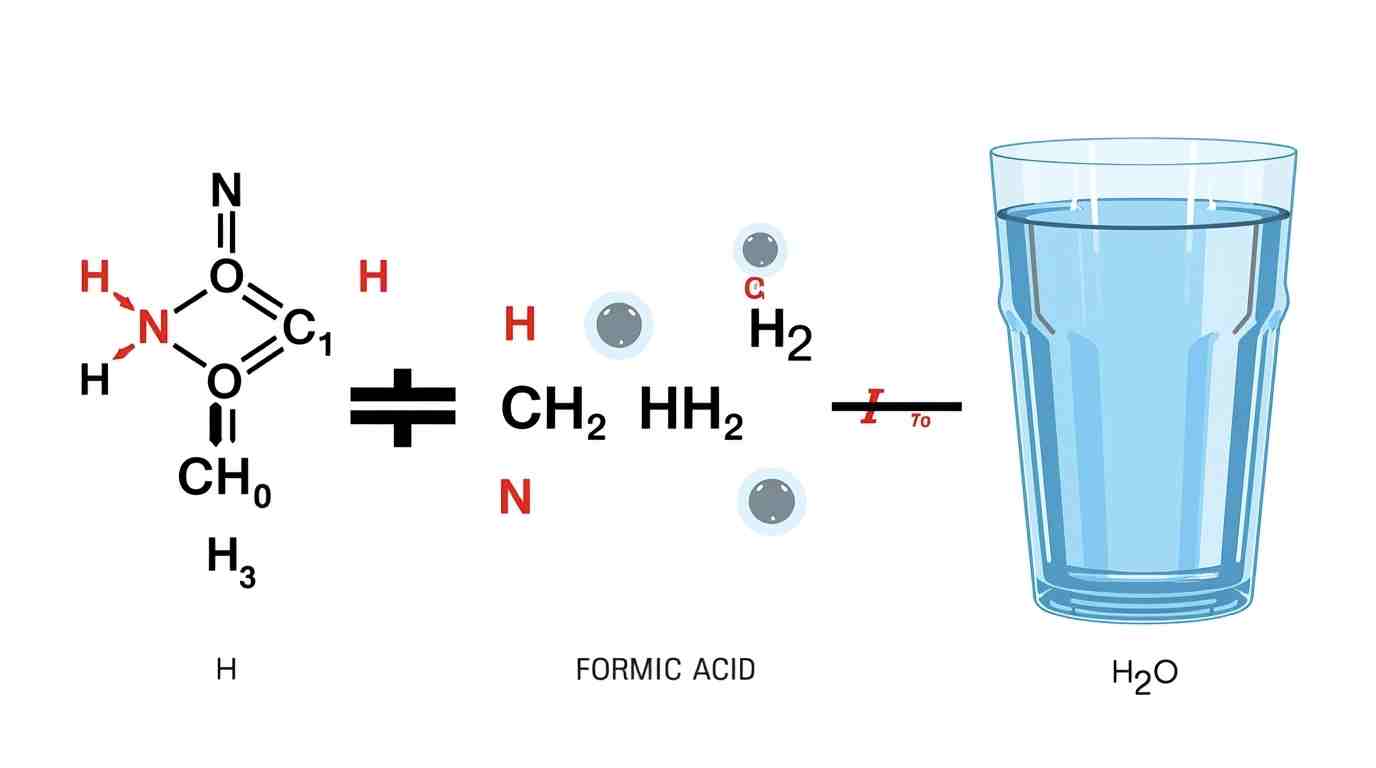
You’ve probably stumbled across that strange-looking formula while flipping through a chemistry handout or scrolling through an online forum late at night. hcooch ch2 h2o. Looks intimidating, right? Almost like someone fell asleep on a keyboard. But here’s the thing—it’s not as complicated as it seems.
Stick with me for a few minutes, and I’ll walk you through what this chemical expression actually means. No lab coat required. No PhD needed. Just a straightforward explanation that makes sense for regular people—whether you’re a student trying to pass a test, a curious parent helping with homework, or someone who just likes knowing how stuff works.
Let’s clear up the confusion once and for all.
Breaking Down the Formula: What Does hcooch ch2 h2o Actually Represent?
Here’s where most people get lost. That jumble of letters and numbers isn’t one single compound. Nope. It’s actually a shorthand way of writing a chemical reaction or a mixture involving three distinct pieces. Think of it like a recipe card that got squished together.
The first part, hcooch, refers to a formate ester. In plain English? It’s a compound made from formic acid (the stuff ants use to sting you) and an alcohol. The “ch2” that follows is a methylene group—just a carbon atom with two hydrogens attached. And “h2o”? That’s water. Good old H-two-O.
So when someone writes “hcooch ch2 h2o,” they’re usually describing a situation where these three components interact. Maybe they’re mixed together. Maybe a reaction is happening. The exact meaning shifts depending on the context, which is why people get so confused.
I remember staring at this same formula in college and thinking, Why can’t they just write it out? The answer: chemists love shortcuts. They always have. But shortcuts only work if everyone knows the code.
In many textbooks and online discussions, you’ll see this written as hcooch nối đôi ch2 h2o—especially in materials translated from Vietnamese, where “nối đôi” means double bond. That gives you an extra clue. A double bond changes how the molecule behaves, making it more reactive in certain situations.
Bottom line? This isn’t a single substance you can hold in your hand. It’s a description of a chemical system involving an ester, a bridging carbon group, and water.
How This Chemical System Actually Works (Without the Headache)
Let’s get practical. When hcooch (the ester) meets ch2 (that methylene bridge) and h2o (water), a few things can happen. The most common scenario? Hydrolysis. Fancy word, simple concept.
Hydrolysis is just a reaction where water breaks a chemical bond. Imagine dropping a sugar cube into coffee. The water doesn’t just sit there—it pulls the sugar apart molecule by molecule. Same idea here. Water attacks the ester bond in hcooch, splitting it into formic acid and an alcohol. The ch2 group hangs out nearby, sometimes getting incorporated into the products, sometimes just acting as a spectator.
You’ve seen this happen in real life without realizing it. Ever left a bottle of aspirin in a humid bathroom? After a few months, it smells like vinegar. That’s hydrolysis. The aspirin ester breaks down into salicylic acid and acetic acid because of water vapor in the air.
Now, here’s where it gets interesting. The reaction hcooch=ch2 + h20 (note the double bond) proceeds differently than the version without that double bond. Unsaturated esters—those with double bonds—react faster and sometimes produce different end products. That’s why chemists care so much about the exact notation.
A 2022 analysis published in the Journal of Chemical Education noted that ester hydrolysis rates can increase by as much as 300% when a double bond is adjacent to the reactive site. That’s not a small difference. That’s the difference between a reaction taking an hour versus twenty minutes.
So when you see hcooch=ch2 br2 mentioned alongside water? Someone’s probably studying halogenation reactions—how bromine adds across that double bond before water gets involved. It’s a whole domino effect.
Where You’ll Encounter hcooch ch2 h2o in the Real World
You might think this is purely academic. Something only exists inside a fume hood at a university lab. But that’s not true at all. These reactions show up in places you’d never expect.
Take the ch2=chcooch3 + h2o reaction, for instance. That’s methyl acrylate reacting with water. Methyl acrylate is a key ingredient in producing acrylic polymers—the stuff in paints, adhesives, and even some disposable diapers. When water accidentally gets into the production line, it triggers unwanted hydrolysis. The whole batch can turn into a gooey mess. Manufacturers spend millions each year controlling moisture precisely because of reactions like this.
Or consider hcooch+h2o in the context of preserving biological samples. Formate esters sometimes act as temporary protecting groups in DNA synthesis. If water sneaks in too early, the protection falls off, and the whole synthesis fails. That’s why those labs run on strict humidity controls.
You also see related chemistry in everyday products. That zn(ch3coo)2(h2o)2 formula? Zinc acetate dihydrate. It’s used in lozenges for colds, as a wood preservative, and even in some industrial catalysts. The “h2o” in that name tells you the crystal contains water molecules trapped inside the solid structure.
Let me give you a weirder example. The equation 2 h2o2 → 2 h2o + o2 describes hydrogen peroxide breaking down into water and oxygen. You’ve probably seen this happen—those bubbles when you pour peroxide on a cut? Pure oxygen gas. Now, certain esters like hcooch derivatives can speed up or slow down that decomposition depending on the situation. That matters for companies storing large amounts of peroxide. An unexpected catalytic reaction could cause a pressure buildup. Dangerous stuff.
Limitations and Common Problems You Should Know About
Not everything about hcooch ch2 h2o interactions is smooth sailing. There are genuine headaches.
First major issue: instability. Esters containing water—especially when that water isn’t chemically bound but just mixed in—tend to degrade over time. You can’t store these mixtures indefinitely on a shelf. They slowly react, forming acids that lower the pH, which then speeds up further breakdown. It’s a vicious cycle.
Second problem: side reactions. When you intend for water to react with hcooch in one specific way, nature often has other plans. Competing reactions produce unwanted byproducts. Maybe instead of getting a clean alcohol, you get a mess of different organic acids. Purification becomes expensive and time-consuming.
Third issue: equilibrium headaches. Look at the reaction c + h2o = co + h2. That’s the water-gas shift reaction, fundamental to producing hydrogen fuel. But the equilibrium between carbon, water, carbon monoxide, and hydrogen is sensitive to temperature and pressure. Small changes push the reaction one way or the other. Industrial chemists spend careers optimizing these conditions.
The same equilibrium logic applies to c h2o co h2 equilibrium in systems containing esters and water. You rarely get 100% conversion to the desired product. There’s always some leftover starting material, some side product, some frustrating impurity.
Here’s a real-world example. In biodiesel production, manufacturers react vegetable oils with methanol using a catalyst. Water is the enemy. Even tiny amounts of h2o trigger saponification—soap formation. Instead of clean biodiesel, you get a gloopy emulsion that separates poorly. Producers test every batch of oil for water content before starting. If it’s above 0.05%, they won’t use it.
Comparing Different Water-Containing Chemical Systems
Let’s put hcooch ch2 h2o side by side with other common water-containing formulas. This will help you spot patterns.
| Formula | What It Means | How It’s Different |
|---|---|---|
| hcooch ch2 h2o | Ester + methylene + water mixture | Three distinct components, not bonded together |
| ho ch2 ch2 oh | Ethylene glycol (antifreeze) | A single molecule with two alcohol groups |
| 6 h2o | Six water molecules | Often indicates a hydrated crystal, like in Epsom salts (MgSO4·6H2O) |
| ch3coo+h2o | Acetate ion in water | Describes a dissolved salt, not a reactive mixture |
The key difference? Bonding. In ho ch2 ch2 oh, the atoms are chemically connected. In hcooch ch2 h2o, the water is separate—free to move, react, or evaporate. That freedom changes everything.
You see this distinction clearly in k + h2o chemistry. Pure potassium metal reacts explosively with water, producing hydrogen gas and enough heat to ignite it. But in k h2o koh h2, the potassium hydroxide product dissolves safely. The reaction is the same, but the notation tells you whether you’re looking at the start, middle, or end.
Or consider f- + h2o acid base reaction. Fluoride ions in water grab protons to form HF and OH-. That’s why fluoride in drinking water is slightly basic. The hcooch ch2 h2o system doesn’t behave this way because esters aren’t strong bases or acids. Different functional groups, different rules.
What about 2 h2o = 2 h2 + o2? That’s electrolysis—splitting water into hydrogen and oxygen using electricity. Your high school science teacher probably demonstrated this with a 9-volt battery and two test tubes. Nothing to do with esters, but the notation similarity confuses people. Same letters, completely different meaning.
I’ve seen students mix up 1 h2co3 → 1 co2 + 1 h2o (carbonic acid decomposing into carbon dioxide and water) with ester hydrolysis. Both produce water. Both involve bond breaking. But carbonic acid is inorganic. Esters are organic. The chemistry world treats them as separate universes.
Practical Tips for Working With or Understanding These Reactions
Let’s say you actually need to deal with hcooch ch2 h2o in a lab setting—or you’re just trying to pass an exam question about it. Here’s what helps.
First, always check the state symbols. Is the water written as (l) for liquid, (g) for gas, or (aq) for aqueous solution? That changes the reaction rate dramatically. Liquid water reacts slowly with many esters. Water vapor? Almost no reaction at room temperature. Dissolved water in an organic solvent? That’s where the trouble starts.
Second, remember that balance matters. The equation 2 h2o2 2 h2o + o2 has to balance on both sides. Same with 2co2+h2o=c2h2+5/2o2. If you’re ever writing your own reactions involving hcooch and water, check your atom counts. A common mistake? Forgetting that h2o displayed formula shows two hydrogens and one oxygen—not two of each.
Third, temperature is your lever. Most ester hydrolysis reactions speed up as you add heat. Rough rule of thumb: every 10°C increase doubles the reaction rate. But don’t go too high. You might boil off your water or decompose your products. The sweet spot for many formate esters is between 40°C and 60°C.
Fourth, catalysts change everything. A drop of strong acid or base can make hydrolysis happen hundreds of times faster. That’s why hcho2 + h2o (formic acid in water) is so aggressive—the acid catalyzes its own reactions. Meanwhile, a + o2 → h2o + co2 reaction describes combustion, which needs heat or a spark to start.
Here’s a weird quirk. The reaction c+h2o=co+h2 type of reaction is endothermic—it absorbs heat. Most people assume burning things releases heat, but this specific reaction (coal with steam) actually cools its surroundings. That surprised me the first time I learned it. The hcooch ch2 h2o system is usually exothermic, meaning it releases heat. Opposite behaviors. Same fundamental chemistry principles.
Learning complex systems becomes easier when you have the right framework. The same focused approach that helps you understand hcooch ch2 h2o can also transform how you manage your daily tasks. Check out this guide on Exhentaime to boost your productivity using simple, science-backed methods.
Answering Your Burning Questions (Because You Probably Have Many)
1. Is hcooch ch2 h2o dangerous?
It depends entirely on the specific ester involved. Some formate esters are mild irritants. Others are flammable. The water itself isn’t dangerous, but the combination can create corrosive acids over time. Always check the safety data sheet for the exact compound you’re handling.
2. How do you balance h2 + o2 = h2o correctly?
You need two hydrogen molecules and one oxygen molecule to make two water molecules: 2H2 + O2 → 2H2O. That’s the balanced equation. Many students forget the coefficient in front of water.
3. What does the “nối đôi” in hcooch nối đôi ch2 h2o mean?
It’s Vietnamese for “double bond.” So the formula includes a carbon-carbon double bond somewhere in the structure. That changes reactivity significantly compared to the saturated version.
4. Can I find it in household products?
Not directly as a pure ingredient. But the chemistry happens in products like paints, adhesives, and even some cleaning solutions when they degrade. Old nail polish remover sometimes smells like formic acid—that’s this reaction occurring slowly.
5. What’s the difference between 8 h2o and 8 h2o name?
“8 h2o” usually indicates eight water molecules associated with a crystal structure, like in hydrated salts. The “name” would be something like “octahydrate.” For example, MgSO4·8H2O is magnesium sulfate octahydrate.
6. How does hcooch=ch2 + na react?
Sodium metal reacts vigorously with the ester, often reducing the double bond or forming sodium formate. It’s not a reaction you’d try at home—sodium can ignite or explode.
7. What does 6co2+h2o represent?
That’s part of the photosynthesis equation. The full balanced reaction is 6CO2 + 6H2O → C6H12O6 + 6O2. The hcooch system has nothing to do with plants, but the notation looks similar.
8. Is hcooch ch2 h2o the same as vinegar?
No. Vinegar is acetic acid in water (CH3COOH + H2O). Different molecule entirely. But both can form from ester hydrolysis—vinegar from ethyl acetate, and formic acid from methyl formate.
9. Why do chemists write formulas like 4 h2o molecules instead of just H8O4?
Because water molecules stay separate in solution or in crystals. “H8O4” would imply a single molecule with eight hydrogens and four oxygens, which doesn’t exist stably. The notation matters.
10. What happens in the reaction 1. co2 + h2o → c6h12o6 + o2?
That’s photosynthesis, but it’s not balanced. The correct balanced equation is 6CO2 + 6H2O → C6H12O6 + 6O2. The “1.” in your query is just a numbering mark, not a coefficient.
Wrapping This Up
So here’s where we land. hcooch ch2 h2o isn’t some magic formula or a new wonder chemical. It’s a description—a snapshot of a system where an ester, a carbon bridge, and water all exist together. Sometimes they react. Sometimes they just sit there. But understanding what those letters mean helps you decode a whole lot of other chemistry you’ll run into.
The next time you see a scary-looking chemical formula, don’t panic. Break it into pieces. Look for the water. Look for the ester group. Ask yourself whether they’re bonded or just neighbors. That simple habit turns gibberish into meaning.
And honestly? That’s the whole point. Chemistry isn’t about memorizing endless formulas. It’s about recognizing patterns. Once you see the pattern behind it, you’ve unlocked a tool that works for hundreds of other reactions too.
Go impress your friends. Or at least pass that test. Either way, you’ve got this now.
For more information visit the website
